16
2015Notes as Your Visual Aid
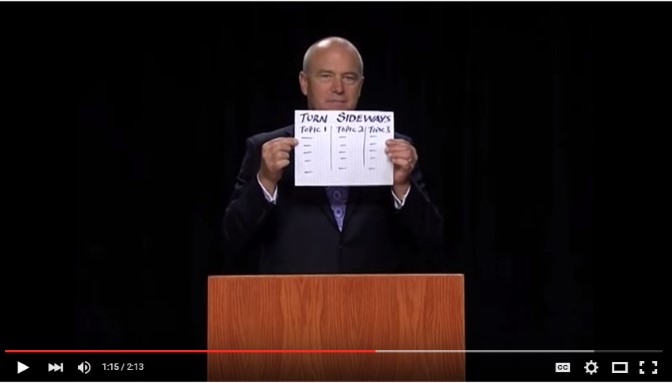 Notes are often a necessity in public speaking. They help you structure and remember what you want to say, and are a comforting security blanket when your mind goes blank. Truly useful notes are visual aids — big, bold, and simple. A stack of index cards won’t work. You need notes that you can see at a distance. Whether they are on the lectern or on counsel table, you want to be able to glance at them and have the words jump off the page.
Here are some simple rules to help you create good notes for speaking.
Write big. Make big notes that are easy to read, so that when you glance at them, the words leap off the page. You’ll be amazed at how much easier it is to speak with notes you can read easily. Notes written too small are indecipherable lying on counsel table three or four feet away. Consider the distance your eyes are from the page that you are reading now. If your notes are lying on a lectern twice the distance from your eyes, shouldn’t they be written twice as big?
Write legibly. Carefully print your notes so that they are legible. Key words, dates, or dollar amounts could be printed in red to highlight their importance; emphasize important words with a yellow highlighter. When you write legibly as well as large, it prevents you from putting too many words on a page. That’s a good thing, because it reinforces the next rule.
Keep notes simple. Less is more. Fewer words are more useful. Boil down your big ideas to just a few words that will trigger the whole thought. Remember, the more words you put on paper, the less useful the notes become. Avoid complete sentences. Write down the structure of your ideas, then improvise around that structure. Don’t waste space writing, “Good morning, members of the jury, my name is … ”
Keep notes handy. Place your notes where you can see them easily. If you are required to speak from behind a lectern, step back about 12 inches—reading your notes should require only a downward shift of your eyes. If you step to the side of the lectern, position yourself so that you can see your notes without moving your feet. Stand still where you can see your notes, especially if you need to look at them often.
A final tip is to arrange your notes horizontally. Watch this 2-minute video to learn about horizontal notes and for more tips on how to make your notes work for you.



Richard I. Garber
Marsha:
Excellent article. Also, you could either tape together two 8-1/2×11 or legal sheets (or use 11×17″) ledger paper to have notes the size of a restaurant menu.
Preparing for an on-line (Webinar, Skype, Google Chat) presentation? Here are 10 things to remember. - Employment Law Matters
[…] to move seamlessly among the points that you’ve covered. (Johnson & Hunter, Inc. has posted a great article on Notes as Your Visual Aid for public […]